Reflections of
INHERITANCE
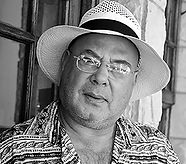
by Mike Rossi
For the last four years of my life I have made weekly trips to the sprawling local informal settlement next to Grabouw. You can’t miss it five kilometres on from Sir Lowry Pass along the N2, on the left. The glints of thousands of newly erected corrugated shacks will make you feel like you have just discovered a new Kimberley diamond field. Your natural reaction would be to scream, “Eureka”. Once you’ve got over the blinding experience you are more likely to say, “Mein Gott”. Don’t be too distracted as people with no sense of direction cross the busy highway with one intention to get to catch a lift from continual passing taxi’s who have their own rules of the road.
One reason for me to enter the settlement camp was to drop off casual labour. The other was to photograph life within. I have always been curious of shack life, and of course, very nervous. I was always accompanied by a ‘bodyguard of sorts’, who were generally more afraid than I was. In fact, I soon found, they would avoid the dangerous areas. I would push to visit, but the answer I would get,
“They will smash up your bakkie and steal everything.”
“And what about me?” I always asked,
“Maybe if you smile they won’t kill you.” He’d say with his big black eyes boring into me, to try and demonstrate the severity of such action.
I soon discovered that often my bodyguard’s fear was related to being of one ethnic class moving into another ethnic area. Zulu’s like to be with Zulu’s and Malawian’s, Zimbabwean’s the same. It’s natural. Dogs see me as a foreigner as much as the scrounging baboons and hungry pigs that are permanently ravenous.
The rambling location which I guess started in Pineview, that is now several kilometres in diameter, travelling westwards, did not exist in 2010. The settlement is divided into ghettos within one large ghetto. You have the Xhosas in one suburb, called Siyanyanzela, meaning, The land we took by force, which they did through conflict with the landowners, police and anybody that objected. Adjacent is Naledi, meaning Peace - a complete dichotomy in philosophy, is a mixed community. The coloureds, depending on hierarchy live in, Pineview, Snake Park, Beverly Hills and Melrose Place. The Zimbabweans, Zulu, Somalians, Nigerians, Malawians and other ethnic groups fit in where there are accepted. In-between, the gangsters, drug dealers and robbers live, hence barbed-wired is on practically every shack and house.
This informal settlement, like so many, is the cause of many unhealthy fractions. In an environment of economic segregation and concentrated poverty the chances for success are minimal.
How many make their way out of it to a better life? One in a thousand? One in five thousand? One in fifty thousand? But some do. There are entrepreneurial auto-electricians, hair-dressing salons, barber, bakers, butchers, pigs, cattle and sheep breeders.
But most do not manage a better life. Instead, turn to apathy, crime, alcohol and drug dealing, waiting for their life to come to an end.
Children throw rocks at passing cars, causing accidents, just for the fun of seeing a car crash. The settlement’s high unemployment breeds frustration which inevitably leads to at times weekly violent demonstrations. It is the innocent surrounding residents and passerby that have to deal with it. Some blame the government for their failed policies and encouraging a migrant track between the Eastern Cape and Grabouw through to Cape Town. Others blame the farmers for importing labour from the Eastern Cape on a one-way ticket. Their legacies, whatever the reasons, when you enter the environment of shack homes you will see a simplicity of life devoid of the trappings of middle class. No painted walls, or art as you see in trendy coffee-table books - just the basic necessities. Maybe a run-down fridge if they are on the upper class echelons of the settlement or probably a cooler box if they are not. For the majority, those with a tin shack and a blanket floor — have nothing.
This informal settlement is their inheritance.
In my conversation with my friend Freedman I asked who he thought might be brave enough, or have the balls to purchase a print showing the grim realities of life in an informal settlement.
Someone who has got out. Patrice Motsepe, he answered or anyone who grew to success from poverty. And if anyone asked why leaders who could afford Picassos in their elegant homes and boardrooms, who would prefer to adorn their walls with photographs of life in an informal settlement, they might well say, “This is our heritage. This is to remind us where we came from. These are the people who we all serve.”
Whenever you are in doubt, or when the self becomes too much with you, apply the following test. Recall the face of the poorest and the weakest man whom you may have seen, and ask yourself if the step you contemplate is going to be of any use to him. Will he gain anything by it? Will it restore him to a control over his own life and destiny? In other words, will it lead to swaraj for the hungry and spiritually starving millions?