
When Photographs Need Words

On a deserted Utah beach, everything is peaceful. The horrors of war are long gone, yet something lingers, difficult to define, held in the atmosphere.
Light rain turns to a heavy downpour and I seek shelter in an abandoned concrete gun emplacement, an unlikely refuge. Alone inside, I find a window onto the world. It feels less like a view and more like a cinema screen, the moving image momentarily stilled. Colour is diluted, softened through the veil of rain.
Within the enclosure, limited natural light clears the darkness only around the opening; everything else remains unseen. The scene begins to carry a quiet sense of remembrance. Making the photograph feels less like a challenge, more like an act of acknowledgment.
Photography is often described as a universal language.
A successful photograph can cross cultures, generations and languages without the need for translation. It has the remarkable ability to communicate through observation alone.
So why write anything at all?
It is a question I have often asked myself.
If a photograph is capable of speaking for itself, surely adding words risks saying too much.
Yet over the years I have found myself writing more, not less.
Not because the photographs are unable to stand on their own.
But because there are occasions when words can quietly open another door into the work.

There are many photographic books that contain little or no text.
Others include essays, introductions, captions or personal reflections.
Neither approach is right or wrong.
Each photographer must decide how much, or how little, the work asks of language.
For me, the words have never been intended to explain a photograph.
If they begin telling the viewer what to think, they have probably gone too far.
Instead, I hope they provide another dimension surrounding the photograph.
A thought.
A memory.
A question.
A fragment of experience that existed before or after the shutter was released.
The photograph remains complete.
The words simply invite another way of entering it.
Writing about photographs is surprisingly difficult.
The irony is that the fewer words used, the harder they often become to write.
A short introduction may go through countless revisions.
Entire paragraphs disappear.
Sentences are rewritten again and again.
Not because the meaning has changed, but because the words have yet to find their proper place.
The same is true when giving a photograph its title.
Some seem to arrive already named.
Others resist every possibility.
A title should sit comfortably beside a photograph.
Not compete with it.
Not explain it.
Simply become part of its identity.
I remember spending hours discussing possible titles with my friend and fellow photographer Mike Rossi. It rarely mattered whose photograph it was. The conversation was always the same. We were searching for words that felt as considered as the photographs themselves.
Those discussions taught me that words deserve the same patience as pictures.

It’s 8.30am Saturday. The muggy air camouflaged with essence of grilled chicken. His party has started; probably quite some time ago. He raps in Xhosa, his musical inheritance. His hand an imaginary microphone. A quart bottle of beer to steady him. The hawkers are amused. He feeds of their approval offering a series of break-dancing moves. But his intoxicated limbs can’t cope. He falls over. They laugh. He stands up. We clap. He smiles, then lurches along jiggling, singing a befuddled song.
The writing that accompanies my own projects has gradually become another part of the creative process.
Different projects ask for different kinds of writing. Sometimes only a title is needed. Sometimes a few notes. Occasionally an essay. The photographs themselves decide.
They all begin in much the same way as the photographs themselves.
With observation.
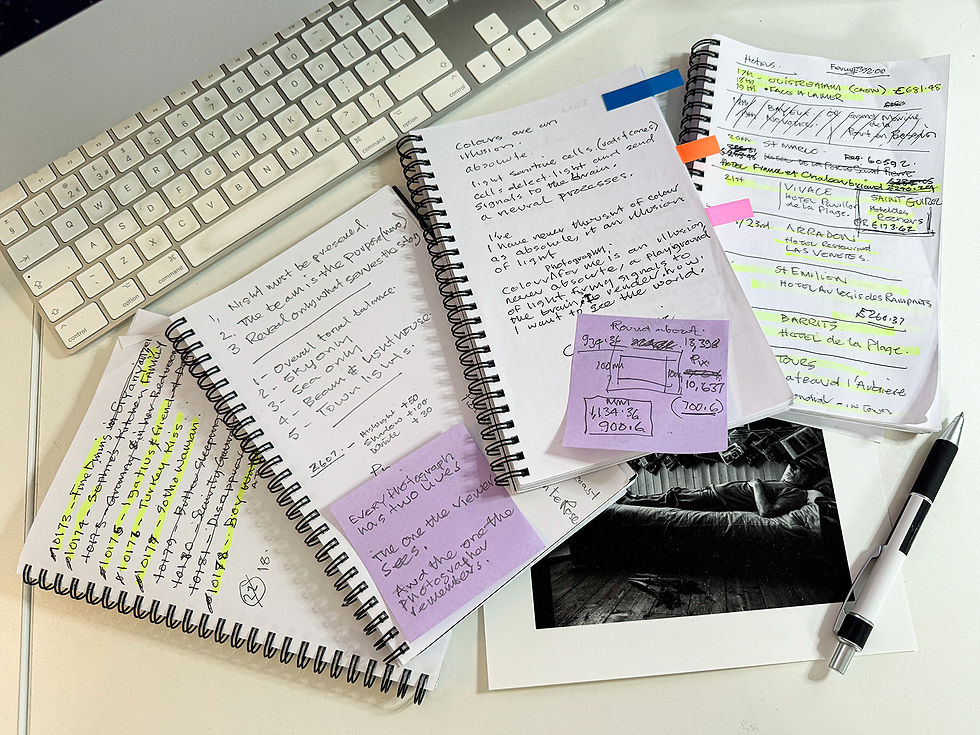
Most of what I write never survives.
Drafts are abandoned.
Ideas are crossed out.
Pages are rewritten.
That may seem excessive for a few hundred words, but those words eventually become part of the work's identity.
Not because they describe the photographs.
Because they reflect the way the photographs came into being.
Perhaps that is why photographs sometimes need words.
Not to complete them.
Not to justify them.
And certainly not to explain them.
Rather, to release another dimension surrounding the image.
The photograph remains the heart of the work.
The words simply create a space where the viewer may pause a little longer.
Just as a photograph asks us not only to look, but to see...
Sometimes a few carefully chosen words invite us to look more deeply at what we have seen.
A photograph invites us to look.
A few carefully chosen words may invite us to look again.

Chris Page


Comments